Giannadakis, R., Papadopoulou, M., & Liu, H. (forthcoming). Parallel wisdom: Modeling ancient Greek and Chinese philosophers. In TOTh 2026 – Terminology & Ontology: Theories and Applications Conference Proceedings. Presses Universitaires Savoie Mont Blanc. Book of abstracts →
Curriculum Vitae
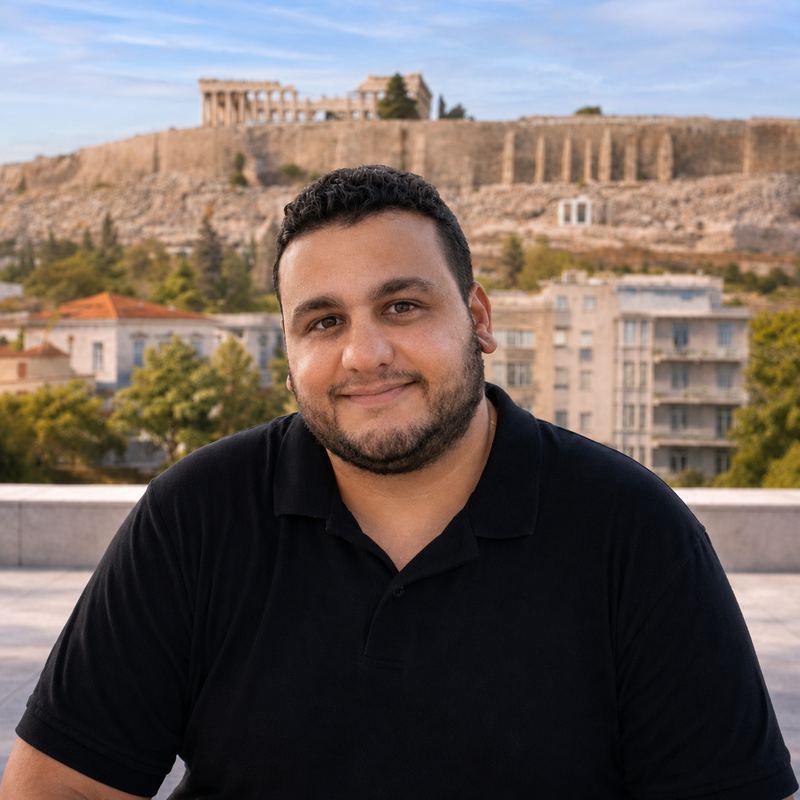
Rafail Giannadakis
giannadakis.uni@gmail.com ·
rgiannadakis@ucsb.edu
Personal Website ·
LinkedIn ·
ORCID ·
Academia.edu
About
I am a PhD student in Classics at the University of California, Santa Barbara, and hold a BA in Philology, specializing in Classical Studies, from the University of Crete. My research interests center on Greek lyric, especially the melic poetry of Pindar and Sappho, Platonic philosophy, and Senecan tragedy. Across these areas, I am particularly interested in questions at the intersection of poetics and aesthetics, especially how literary form, imagery, and representation participate in meaning-making. This perspective informs my interests in the literary dimensions of philosophical discourse, representations of women, and the role of material culture in poetic construction.
Alongside my philological research, I work in digital humanities and computational approaches to Classics and the humanities more broadly, including semantic technologies, knowledge representation, and ontoterminology. My work explores how these methods can support the modeling, analysis, and interpretation of ancient texts and languages and contribute to research, teaching, and humanistic inquiry.
Before joining UCSB, I worked as a Research Assistant on the EU-funded TALOS–AI4SSH ERA Chair project at the University of Crete, where I contributed to research, publications, and training at the intersection of Classics, digital humanities, and semantic technologies. My studies at UCSB are supported in part by the 2026–2027 Fulbright Foreign Student Program and the A. G. Leventis Foundation.
CV
Education
2026–Present:
PhD in Classics, University of California, Santa Barbara. Expected 2031.
2021–2025:
BA in Philology (Ptychio), specializing in Classical Studies, University of Crete. Grade: «Άριστα» [Excellent] — 9.42/10. Ranked second in the graduating cohort (four-year BA, per the Greek higher-education system).
2018–2021:
Upper Secondary School (Lykeio), 3rd Day Lykeio School of Rethymno. Final grade (Apolytirion): «Άριστα» [Excellent] — 19.9/20.
2015–2018:
Lower Secondary School (Gymnasio), 3rd Day Gymnasio School of Rethymno. Final grade (Apolytirion): «Άριστα» [Excellent] — 19 3⁄14/20.
Other Education & Certificates
2023–2025:
Level B Short Program–Diploma in Digital Humanities, TALOS–ERA Chair in AI for SSH, University of Crete. 60 ECTS. Grade: «Άριστα» [Excellent] — 10/10. Courses and seminars covered digital humanities, knowledge graphs and ontologies, knowledge modelling in Classical Studies, AI ethics, programming, AI in education and museum studies, digital literature, and AI-based narrativity. Received the €1,000 Excellence Award for top academic performance in the program (see Awards & Scholarships).
2023–2025:
Pedagogical and Teaching Competency Certification, Faculty of Letters, University of Crete. Courses included teaching methodology, developmental psychology, educational theories, teaching the past, the teaching of ancient languages, a teaching practicum at a local upper secondary school (Lykeio).
April–July 2024:
Computational Palaeography and Papyrology, KEDIVIM, Athens University of Economics and Business. 5 ECTS, 150 hours. Grade: «Άριστα» [Excellent] — 100/100.
2021–2023:
Academic Skills and Writing Center courses, Writing Center, School of Philosophy, University of Crete. Courses included essential academic skills, academic essay writing, editing and proofreading, exams and essays, and academic reading skills.
2021–2022:
English for Academic Purposes, Faculty of Letters, University of Crete. Three semesters.
Awards & Scholarships
2026–2031:
Chancellor’s Fellowship, Graduate Division, University of California, Santa Barbara. Five-year funding package comprising fellowship support in Years 1, 3, and 5 and academic employment in Years 2 and 4.
2026–2027:
Fulbright Foreign Student Program for Graduate Studies, Fulbright Foundation in Greece, for graduate studies in Classics at the University of California, Santa Barbara. Fulbright Greece profile →
2026–2027:
A. G. Leventis Foundation Educational Grant, awarded to support doctoral studies in Classics at the University of California, Santa Barbara, during the 2026–2027 academic year.
November 2025:
Level B Short Program–Diploma in Digital Humanities Award, TALOS Lab, Department of Philology, University of Crete. Awarded for excellent academic performance. Amount: €1,000.
September 2025:
Zoi Dimitriadis Scholarship, University of Crete. Awarded for high academic performance in undergraduate studies in the Department of Philology. Amount: €2,000.
July 2025:
Second Prize, Elisavet Karamintzou Award, University of Crete. Awarded for the second-highest academic performance among that year’s graduates and for completing the degree on time. Amount: €400.
March 2025:
Book Voucher, Department of Philology and Crete University Press, University of Crete. Awarded for high academic performance in the third year. Amount: €100.
Work Experience
February 2024–July 2026:
Research Assistant and Social Media Manager, TALOS–ERA Chair in Artificial Intelligence for Humanities and Social Sciences, University of Crete. Funded by the European Union. Project ID: 101087269 (CORDIS). Contact: Assistant Professor Maria Papadopoulou, Project Manager.
Summary of activities:
- Data and research: Curated and developed two open linked-data resources focused on ancient Greek philosophy and archaic Greek lyric poetry; presented related research at international conferences and contributed to conference publications.
- Training and MOOCs: Co-created training materials and served as an instructor for multiple training programs and one MOOC.
- Communication and dissemination: Managed the project’s Facebook, Instagram, LinkedIn, and X accounts; maintained the project website and authored event blog posts.
- Events and technical support: Supported hybrid lectures and events, including the 2025 and 2026 SA4AW International Conferences and the TALOS–AI4SSH Summer School in September 2025.
- Conference organization: Member of the Organizing Committee for the TOTh 2025 and 2026 International Conferences.
June 2026:
Technical, data management, promotional, and administrative support, Crete Past and Present: Receptions of Crete Summer School, Division of Classical Studies, Department of Philology, University of Crete. Contact: Associate Professor Zacharoula Petraki, Scientific Coordinator of the Summer School.
June 2025:
Technical, data management, promotional, and administrative support, Crete Past and Present: Crete on Stage Summer School, Division of Classical Studies, Department of Philology, University of Crete. Contact: Associate Professor Zacharoula Petraki, Scientific Coordinator of the Summer School.
Organizing Conferences
February 2025–Present:
TOTh International Conference, organized by TALOS–AI4SSH, University of Crete, and held annually in Chambéry, France, since 2007. Organizing Committee Member (TOTh 2025 and 2026) and TOTh Proceedings Editorial Committee Member.
Conferences, Summer Schools & Other Programs Attended
July 6–10, 2026:
Digital Humanities for Hellenic Studies: Historic Athens in 3D, Summer Institute, Princeton Athens Center, Athens, Greece.
June 2–3, 2026:
TOTh 2026 Online and On-site Training Course, Bringing Artificial Intelligence to Terminology: A Step-by-Step Project Approach, University Savoie Mont Blanc, Chambéry, France. Certificate of Participation.
July 5-18, 2025:
NUAA Short-Term Program (14 days), Nanjing University of Aeronautics and Astronautics, Nanjing, China. Fully funded by NUAA.
June 30-July 7, 2024:
Crete Past and Present, Summer School in Classics, University of Crete, Rethymno, Greece.
September 15-17, 2023:
1st International Conference on Higher Education Pedagogy and Faculty Development: Developing Academics' Pedagogical Acuity, University of Crete, Rethymno, Greece.
July 3-5, 2023:
7th Open International Conference of the Network for the Study of Archaic and Classical Greek Song: What's in a Poet?, Barcelona, Spain.
Voluntary Activities
June 2023–Present:
Usher, Erofili Theatre, Municipality of Rethymno.
September 2023–December 2025:
Assistant, Writing Center, School of Philosophy, University of Crete. Supported academic-skills guidance, student support, teaching materials, digital learning materials, oral-presentation training, and outreach. Contact: Dr. Yiota Samioti, Writing Center Instructor.
June–July 2024:
Technical, data management, promotional, and administrative support, Crete Past and Present Summer School, Division of Classical Studies, Department of Philology, University of Crete. Contact: Associate Professor Zacharoula Petraki, Scientific Coordinator of the Summer School.
April 2022:
University of Crete team member, Discussing Ancient Texts. Participated in a discussion with high-school students on Plato's Republic.
April 2022:
University of Crete team member, Discussing Ancient Texts. Participated in a discussion with high-school students on Aristophanes' Peace.
Publications
Publications
Giannadakis, R. (forthcoming). Towards a conceptualization of an archaic lyrical agora. In TOTh 2025 – Terminology & Ontology: Theories and Applications Conference Proceedings. Presses Universitaires Savoie Mont Blanc.
Giannadakis, R. (2026). Παρατηρώντας την ΠΤΝ: Μια πρόταση για τη διδασκαλία της αρχαίας ελληνικής λογοτεχνίας [Observing GenAI: A Proposal for Teaching Ancient Greek Literature]. In Η εκπαίδευση στην εποχή της ψηφιακής τεχνολογίας και της τεχνητής νοημοσύνης: Πρακτικά Συνεδρίου [Education in the Age of Digital Technology and Artificial Intelligence: Conference Proceedings] (pp. 119–129). Academia.edu →
Samioti, P., & Giannadakis, R. (2026). CDL and critical creativity: Engaging students with AI to counter disinformation in higher education. In Revisiting Disinformation: Critical Media Literacy Approaches. International Conference Proceedings (pp. 121–133). Faculty of Letters, University of Crete. Link →
Giannadakis, R. (2025). Ontologies for Digital Humanities: An example of utilisation in the research and study of Classics. In TOTh 2024 – Terminology & Ontology: Theories and Applications Conference Proceedings (pp. 317–322). Presses Universitaires Savoie Mont Blanc. Link →
Milio, R., Giannadakis, R., & Lourentzaki, A. (2025). Creating ontoterminologies for antiquity: Workflow, challenges and solutions. In Proceedings of the 4th International Conference on Multilingual Digital Terminology Today (MDTT 2025) (pp. 1–12). CEUR Workshop Proceedings (Vol. 3990). Link →
Edited Volumes
Roche, C., Papadopoulou, M., Giannadakis, R., & Vachon, L. (Eds.). (forthcoming). TOTh 2026 – Terminology & Ontology: Theories and Applications Conference Proceedings. Presses Universitaires Savoie Mont Blanc.
Roche, C., Papadopoulou, M., Giannadakis, R., & Vachon, L. (Eds.). (forthcoming). TOTh 2025 – Terminology & Ontology: Theories and Applications Conference Proceedings. Presses Universitaires Savoie Mont Blanc.
Roche, C., Papadopoulou, M., Giannadakis, R., & Vachon, L. (Eds.). (2025). TOTh 2024 – Terminology & Ontology: Theories and Applications Conference Proceedings. Presses Universitaires Savoie Mont Blanc. Link →
Datasets
Giannadakis, R., & Papadopoulou, M. (2024). Archaic Lyric Agora (ALyrA) – ontoterminology of archaic lyric poets (Version 1.0) [Data set]. Zenodo. Link →
Giannadakis, R., Papadopoulou, M., & Roche, C. (2024). Ontoterminology of ancient Greek and Chinese philosophers (Version 1.0) [Data set]. Zenodo. Link →
Presentations
Conference Presentations
Giannadakis, R., Papadopoulou, M., & Liu, H. (2026, June 4). Parallel wisdom: Modeling ancient Greek and Chinese philosophers. Presented at TOTh 2026: Terminology & Ontology – Theories and Applications, Université Savoie Mont Blanc, Chambéry, France. Peer-reviewed
Giannadakis, R. (2026, May 30). Formalizing lyre and chorus: An ontoterminology for archaic Greek lyric. Presented online at the international colloquium New Meanings in Ancient Texts: Modern Reconstructions, Reinterpretations and Recontextualizations of Ancient and Medieval Sources, University of Bucharest, Bucharest, Romania. Peer-reviewed
Giannadakis, R. (2026, March 28). Παρατηρώντας την ΠΤΝ: Μια πρόταση για τη διδασκαλία της αρχαίας ελληνικής λογοτεχνίας [Observing GenAI: A proposal for teaching ancient Greek literature]. Presented online at the 3rd Panhellenic Conference, Education in the Era of Digital Technologies and Artificial Intelligence, Harokopio University, Athens, Greece. Invited
Giannadakis, R. (2025, June 28). Critical creativity: Engaging students with AI to counter disinformation. Presented at the international conference Revisiting Disinformation: Critical Media Literacy Approaches, Rethymno, Crete, Greece. Peer-reviewed
Milio, R., Giannadakis, R., & Lourentzaki, A. (2025, June 20). Creating ontoterminologies for antiquity: Workflow, challenges and solutions. Presented at the 4th International Conference on Multilingual Digital Terminology Today: Design, Representation Formats and Management Systems (MDTT 2025), Thessaloniki, Greece. Peer-reviewed
Giannadakis, R. (2025, June 6). Towards a conceptualization of an archaic lyrical agora. Presented at TOTh 2025: Terminology & Ontology – Theories and Applications, Chambéry, France. Peer-reviewed
Giannadakis, R. (2024, June 7). Ontologies for digital humanities: An example of utilisation in the research and study of Classics. Presented at TOTh 2024: Terminology & Ontology – Theories and Applications, Chambéry, France. Peer-reviewed
Samioti, Y., & Giannadakis, R. (2024, May 11). Η χρήση της τεχνητής νοημοσύνης στην αντιμετώπιση της παραπληροφόρησης στην τριτοβάθμια εκπαίδευση [The use of artificial intelligence in countering disinformation in higher education]. Co-presented at the international conference Language, Education, and Artificial Intelligence, Rethymno, Greece. Peer-reviewed
Invited Presentations
Giannadakis, R. (2026, May 27). Digital transformation in education and research: The TALOS–AI4SSH initiative. Presented at the 3rd Staff Training Week (Erasmus+ KA131) and 5th International Staff Training Week, Rethymno, Crete, Greece. Newsletter link →
Giannadakis, R. (2026, April 23). Παρατηρώντας την Παραγωγική Τεχνητή Νοημοσύνη: Μια πρόταση για τη διδασκαλία της αρχαίας ελληνικής λογοτεχνίας [Observing GenAI: A proposal for teaching ancient Greek literature]. Invited lecture for the undergraduate course AEFF-090: Teaching of Ancient Languages, Department of Philology, University of Crete, Rethymno, Greece.
Tamiolaki, M., & Giannadakis, R. (2026, March 26). Το πρόγραμμα ΤΑΛΩΣ-Τεχνητή Νοημοσύνη για τις Ανθρωπιστικές και τις Κοινωνικές Επιστήμες [The TALOS Project: Artificial Intelligence for the Social Sciences and the Humanities]. Invited talk in the 2025–2026 Spring Webinar Series of the M.A. programme “Digital Humanities: Methods, Tools, Practices,” Hellenic Open University, online.
Giannadakis, R. (2025, December 8). Μοντελοποιώντας αρχαιογνωσία: Τα παραδείγματα της αρχαϊκής λυρικής ποίησης και της φιλοσοφίας [Modelling knowledge in ancient world studies: The cases of archaic lyric poetry and philosophy]. Invited talk at the Logic and Formal Methods Research Group (λ-Form Group), National Technical University of Athens (NTUA), Athens, Greece. Newsletter link →
Giannadakis, R. (2025, December 3). Αναβιώνοντας την αρχαιότητα με ψηφιακά εργαλεία και εφαρμογές της ΤΝ [Reviving antiquity with digital tools and AI applications]. Invited online talk at the General Lykeio School of Lechaina.
Giannadakis, R. (2025, October 10). Φωτίζοντας την αρχαιότητα [Illuminating antiquity: AI and VR/AR in teaching]. Invited presentation at the two-day educational seminar Modern Teaching Approaches in Philological Courses according to the New Curricula, Directorate of Secondary Education of Heraklion, Heraklion, Greece.
Teaching & Training
Training Sessions Given
Papadopoulou, M., & Giannadakis, R. (2026, June 25). Looking for Europa (mal du pays). Hands-on training session delivered at the Crete Past and Present 2026: Receptions of Crete Summer School, Xenia Student Cultural Center, University of Crete, Rethymno, Greece. Report link →
Tamiolaki, M., & Giannadakis, R. (2025, September 8). Πώς μπορεί να συμβάλει η Τεχνητή Νοημοσύνη στη μελέτη και την κατανόηση του αρχαίου κόσμου; [How Artificial Intelligence Can Contribute to the Study and Understanding of the Ancient World]. Training session delivered at the TALOS Summer School: Artificial Intelligence for the Social and Human Sciences 2025, University of Crete, Rethymno, Greece. Link →
Papadopoulou, M., & Giannadakis, R. (2025, June 19). Echoes of the Past, Engines of the Future: AI & Classics. Training session delivered at the Crete Past and Present 2025: Crete on Stage Summer School, Xenia Student Cultural Center, University of Crete, Rethymno, Greece. Link →
Berti-Equille, L., Giannadakis, R., & Milio, R. (2025, June 3–4). Generating Knowledge Graphs with LLMs, prompt engineering, and RAG. Hybrid training session delivered as part of the TOTh 2025 Onsite & Online Training, University Savoie Mont Blanc, Chambéry, France, and University of Crete, Rethymno, Greece. Link →
Giannadakis, R., & Papadopoulou, M. (2024, July 9 and 11). Foundations of the Semantic Web: Querying and modelling ontoterminologies (SPARQL & TEDI). Online short course co-taught for graduate students at Nanjing University of Aeronautics and Astronautics, China. Materials → Video →
Giannadakis, R. (2023, January 5). Supplementary teaching for Introduction to Classical Philology (4.5 hours). Course taught by Professor Lucia Athanassaki, University of Crete, Rethymno, Greece.
Teaching Assistance
Giannadakis, R. (2026, January). Teaching Assistant for Crete and the Aegean from Prehistory to the Early Byzantine Period. Course offered through a collaboration between College Year in Athens and the University of Crete. Supported the academic program and course activities under the supervision of Dr. Nikos Litinas and Dr. Demetrios Kritsotakis.
Educational Resources
Training Materials for Standards in SSH. Online training material, TALOS–AI4SSH, University of Crete. Co-creator (RDF, RDFS, SKOS and OWL). Link →
TALOS – AI for Social Sciences and Humanities MOOC. Online course, TALOS–AI4SSH, University of Crete. Co-creator and instructor (TEDI software and SPARQL). Link →
Samioti, Y., & Giannadakis, R. (2023, March). ΚΓ-015 Προφορική Παρουσίαση [Oral Presentation]. Asynchronous laboratory created for the Writing Center, School of Philosophy, University of Crete. Link →